
Upcoming Contests and Past Winners
Jim Claypool Art & Writing Contest
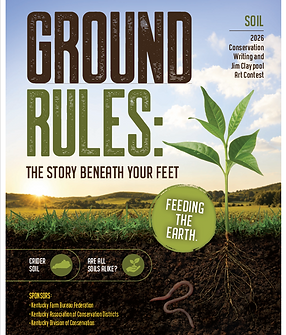
Ground rules: The Story Beneath Your Feet - 2026
Download and share the learning resource tabloid w/ contest entry form on the back page.
Great for various reading levels!

2025 Woodford County Writing Contest Winner
Luke Borth, St. Leo School

2025 Woodford County Art Contest Winner
Matthew Grinevich, Woodford Christian Academy

Thousands of students have participated in the Jim Claypool Art and Conservation Writing contests since their introduction in 1974 and 1944, respectively. The contests educate students on soil, water, forestry and wildlife conservation. Students take the knowledge they have gained and transform it into creative artwork and essays. Students can earn monetary prizes on the county, regional and state levels. They are also recognized each year by conservation districts around the state.
The contest is made possible through the hard work and dedication of sponsors such as the Kentucky Farm Bureau Federation, Kentucky Association of Conservation Districts and 121 conservation districts across the state.
K-5 Grades: ART CONTEST
6-12 Grades: WRITING CONTEST


Rules
-
K-5 Grades: Only students through grade 5 may compete in the art contest.
-
6-12 Grades: Kentucky students grades 6-12 are eligible to compete in the writing contest.
-
A student may not enter both the Jim Claypool Conservation Art Contest and the Conservation Writing Contest during the same contest.
-
An entry must be created by one and only one student. Any entry submitted by more than one student will be disqualified.
-
All entries become the property of the contest sponsors. The decisions of the judges at all levels of competition are final.
-
WRITING: (6-12 Grades) an entry may not exceed 1,000 words and must be written in ink or typed on one side of the paper only. Typed entries must be written in 12pt font, Times New Roman or Calibri. No photographs or artwork may be included with the written work. It is suggested that the written entry take the form of informational writing (from the perspective of an informed writer to a less informed reader) and may be in the form of a letter, blog entry, editorial or speech. It should persuade the reader to take action toward good soil conservation practices or propose a solution to one or more soil conservation issues. The work should be the student author and avoid plagiarism from this source or other sources. Sources should be cited.
-
ARTWORK: (K-5 Grades) shall be 8 ½”x11”. Any thickness or color of art board may be used. Art paper may be used, but must be pasted onto art board or cardboard before submitting for competition. NO plywood will be accepted. Artwork may be rendered in any medium: pencil, ink, charcoal, crayon, oil, etc., but it must be flat art. 3-D art is unacceptable; however, collages, photographs or other art pasted onto your board will be accepted as long as it is flat art pasted securely to the poster board. An art entry may take the form of a poster, newspaper advertisement or editorial cartoon, making sure that whatever form is used the artwork conveys a message at a glance that persuades its viewers to take action toward good soil conservation practices.
-
All writing entries and/or artworks from your school must be submitted to your local county conservation district by December 1st.
-
The official entry form must be completed and secured to the back of your entry.
POINT SYSTEM FOR ARTWORK
-
50 points - Purpose / Audience. (Appropriate communication style to reach an audience, establishes and maintains a purpose; and holds to subject in the community. Theme clearly conveyed at a glance.)
-
30 points - Composition / creativity / craftsmanship. (Layout, originality, and quality of work, such as neatness.)
-
20 points - Language / correctness. (Word choice, usage, spelling, punctuation, capitalization.)
POINT SYSTEM FOR WRITING
-
30 points - Purpose/Audience (establishes and maintains a purpose, communicates with the audience, employs a suitable voice and/or tone)
-
30 points - Correctness (spelling, punctuation, capitalization), Language (word choice, usage), Sentences (varied in structure and length, constructed effectively, complete and correct)
-
20 points - Organization (logical order, coherence, transition organizational signals)
-
20 points - Idea Development/Support and Evidence of Research (student’s original work the show's sources of research
HELPFUL HINTS
-
Keep entry simple and sincere.
-
Be creative and original. Avoid plagiarism by using original words and ideas. Plagiarism is defined as the act of stealing and passing off the words of another as your own without crediting the source.
-
Consider an area of soil that is important to you, your family and your community.
-
Draw from your personal interests or experiences.
-
Writing entry should take the form of informational.
-
Think about soil issues in your community, farm, subdivision or city.
-
DO NOT use the tabloid as your only source.
-
Interview people in your community about changes in soil issues.
-
Find ways to improve soil in your community. TAKE ACTION!
National Association of Conservation Districts Photo Contest

The NACD Photo Contest is open to all amateur photographers who reside in the U.S. or its territories in the following categories:
1. Conservation Practices
-
showcases conservation methods such as contour buffer strips, cover crops, crop rotation, wetland restoration, riparian buffers, and nutrient management.
-
Highlights conservation efforts that support environmental sustainability and resource management.
2. Close-up Conservation
-
Focuses on detailed aspects of conservation such as soil health, water in various forms, insects, farm animals, irrigation techniques, earthworms, roots, and composting.
-
Highlights the small yet significant elements of conservation efforts.
3. Conservation in Action
-
Captures conservation district activities such as educational programs, field days, irrigation use, community meetings, and hands-on conservation practices.
-
Highlights farmers, landowners, district staff, and volunteers engaged in conservation efforts.
4. Agriculture & Conservation Across America
-
Features barns, crops, farm practices, livestock, grazing pastures, tree farms, and youth participating in conservation-related activities. Please ensure that a signed release form is obtained for any youth whose facial features appear in the photograph.
-
Captures the relationship between agriculture and conservation across different regions of the U.S.
One winner is selected for each category and age division.
-
Adult Divsion: 19 and older as of December 1, 2025
-
Youth Division: 18 and younger as of December 1, 2025